
causes, symptoms, treatment and physiotherapy exercises
De Quervain’s tenosynovitis is one of the most common causes of pain at the base of the thumb and along the thumb side of the wrist.
Many people experience discomfort when:
✅ gripping objects
✅ opening jars or bottles
✅ using a mobile phone
✅ typing or working on a computer
✅ lifting weights
✅ carrying a baby
Common diagnoses include:
• De Quervain’s tenosynovitis
• thumb tendinitis
• radial wrist pain
• inflammation of the thumb tendons
👉 Although there are some differences between these terms, they are often closely related and share similar mechanisms of:
✅ irritation
✅ sensitivity
✅ overload of the thumb tendons
🔹 WHAT HAPPENS IN DE QUERVAIN’S TENOSYNOVITIS?
De Quervain’s tenosynovitis primarily affects two important thumb tendons:
✅ Abductor Pollicis Longus (APL)
✅ Extensor Pollicis Brevis (EPB)
These tendons help with movements such as:
• gripping objects
• moving the thumb away from the hand
• lifting the thumb
• stabilizing the hand during daily activities
• performing repetitive hand and wrist movements
When the load temporarily exceeds the tissues’ ability to adapt, irritation and sensitivity may develop.
👉 This can occur during:
• prolonged mobile phone use
• computer work
• caring for a baby
• repetitive manual activities
• training or sports
In some cases, there may also be sensitivity within the joint located at the base of the thumb.
👉 In practice, these structures often work together, and symptoms may overlap.
👉 Although no single question can confirm the exact source of the problem, observing how symptoms behave during daily activities can provide useful information.
For this reason, we invite you to answer a few simple questions.
The goal is not to make a diagnosis, but to help you understand whether your symptoms may be related to De Quervain’s tenosynovitis or irritation of the thumb tendons.
If you identify with most of these situations, the specific physiotherapy protocol may be a good place to start.
🔹 DO YOU RECOGNIZE THESE SYMPTOMS?
Do you feel pain at the base of the thumb or along the thumb side of the wrist?
YES / NO
Does the pain increase when gripping objects or opening containers?
YES / NO
Do you notice discomfort when using your phone, computer, or performing repetitive activities?
YES / NO
Do you find it uncomfortable to lift weights or hold objects for a long period of time?
YES / NO
Do your symptoms increase after certain activities or efforts?
YES / NO
🔹 QUICK TEST FOR DE QUERVAIN’S TENOSYNOVITIS
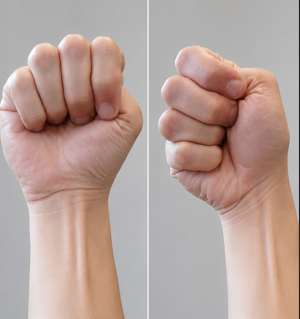
Place your thumb inside your hand and gently wrap your fingers around it.
From this position, slowly bend your wrist toward the little finger side.
If the movement causes:
⚠️ pain at the base of the thumb
⚠️ pain along the thumb side of the wrist
⚠️ a sensation of tightness or irritation
there may be involvement of the tendons commonly affected in De Quervain’s tenosynovitis.
👉 If you identify with most of these symptoms and the test reproduces your discomfort, a specific physiotherapy protocol may help you manage the problem in a more targeted and progressive way.
You can download our specific physiotherapy protocol for De Quervain’s tenosynovitis completely free of charge.
🔹 WHAT YOU WILL FIND INSIDE THE PROTOCOL
👉 Specific exercises developed by physiotherapists, not random exercises.
👉 This protocol has been created by physiotherapists specialized in musculoskeletal rehabilitation.
ANTONIO
I am Antonio, a physiotherapist specialising in musculoskeletal conditions and the founder of PhysioCareHub.

✅ guided physiotherapy progression
✅ progressive loading exercises
✅ specific work for the thumb tendons
✅ mobility and control exercises
✅ clear step-by-step explanations
⬇️ Access the specific physiotherapy protocol for De Quervain’s tenosynovitis
👉 If you do not fully identify with these questions, or if the test is unclear, your pain may not be related exclusively to De Quervain’s tenosynovitis.
In this case, it may be more useful to perform a:
✅ complete wrist and hand self-assessment
to better understand the cause of your symptoms and choose the most appropriate approach.
The assessment includes specific tests designed to differentiate possible joint, muscular, tendon-related, or other wrist and hand conditions.
⬇️ Discover the complete wrist and hand self-assessment
🔹 SUPPORT
If you have any questions or need help:
📧 support@physiocarehub.eu
👉 We are here to help you.
ANTONIO