
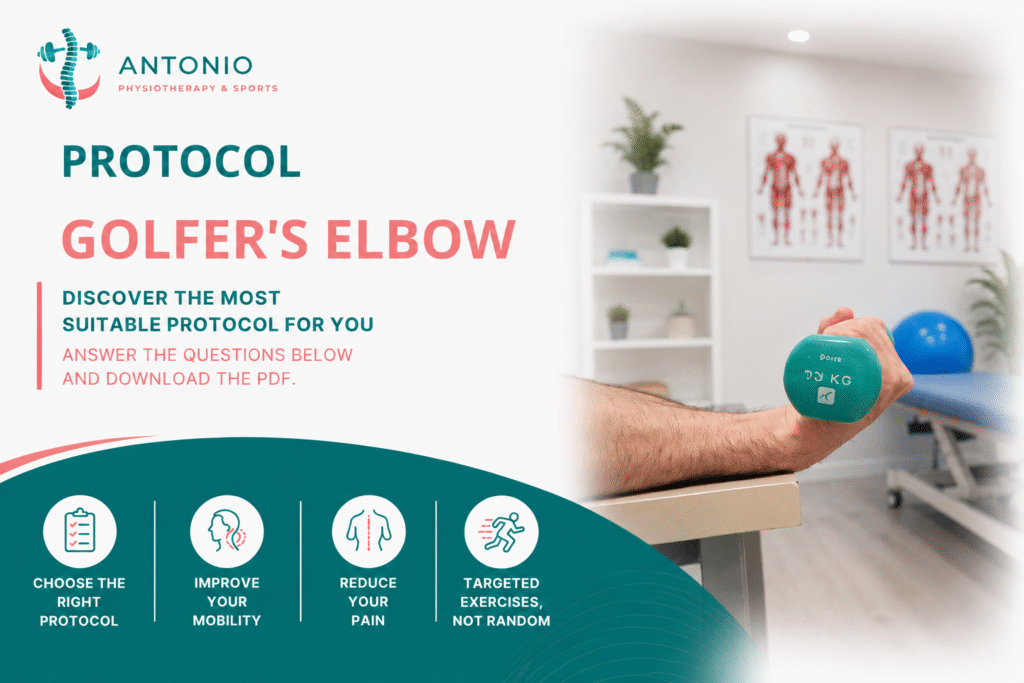
Epitrochleitis, also known as golfer’s elbow, is one of the most common causes of pain on the inner side of the elbow.
It can affect people who practice sports, work long hours on a computer, use tools, lift weights, or perform repetitive movements with the hand and forearm.
The most common symptoms include:
- pain on the inner side of the elbow
- discomfort when gripping objects or applying force
- weakness in the hand and forearm
- pain that may radiate down the forearm
In most cases, this is not a serious injury, but rather an overload of the wrist and finger flexor tendons, which requires a specific and progressive physiotherapy treatment.
To understand whether your pain may be related to epitrochleitis, answer these simple questions.
Do You Recognize These Symptoms?
Do you feel pain on the inner side of your elbow? YES / NO
Does the pain increase when gripping objects, lifting weights, or applying force? YES / NO
Do you notice discomfort during repetitive movements (gym, mouse use, manual work)? YES / NO
Does the pain extend into the forearm or do you feel weakness in your hand? YES / NO
Quick Test for Epitrochleitis
Extend your arm in front of you with your palm facing upward.
From this position, try to flex your wrist and fingers while using your other hand to apply resistance by pushing downward.
If this movement causes pain on the inner side of the elbow, there may be involvement of the flexor tendons, which is typical of epitrochleitis.
If you identify with most of these symptoms and the test reproduces your discomfort, you can download our free physiotherapy protocol to help you address the problem in a more targeted and effective way.
Inside the Protocol You Will Find:
👉 Specific and structured exercises developed by physiotherapists.
👉 This protocol has been created by physiotherapists specialized in musculoskeletal rehabilitation.
ANTONIO

I am Antonio, a physiotherapist specialising in musculoskeletal conditions and the founder of PhysioCareHub.
- guided physiotherapy progression
- targeted work on the tendon and forearm
- clear step-by-step explanations
⬇️ Access the specific physiotherapy protocol for epitrochleitis
If you do not fully recognize yourself in these questions, or if the test is not clear, your pain may not be related only to epitrochleitis.
In this case, it may be more useful to perform a complete elbow self-assessment in order to better understand the cause of the problem and choose the most appropriate approach.
⬇️ Download the complete elbow self-assessment
If you have any questions or need support, we are here to help you:
📧 support@physiocarehub.eu
ANTONIO