
Causes, resources and physiotherapy exercises
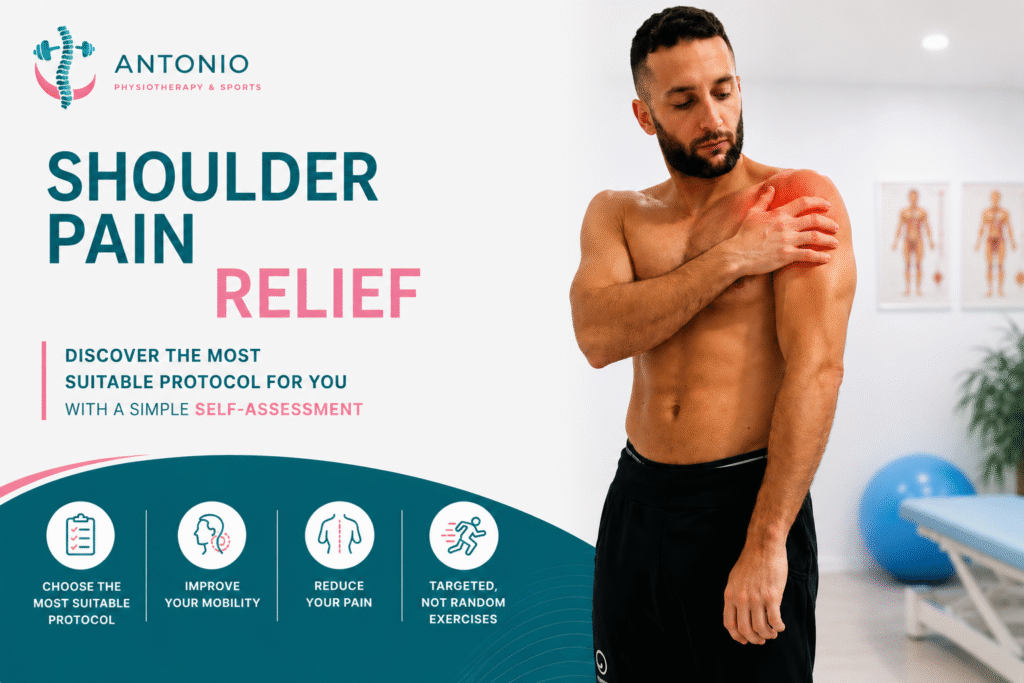
Shoulder pain is one of the most common musculoskeletal problems and can affect people of all ages. This is because the shoulder is one of the most mobile joints in the body and is involved in many daily activities.
When shoulder pain develops, it is common to experience difficulties with:
- Raising the arm.
- Reaching behind the back.
- Lifting the arm out to the side.
- Reaching for objects above head level.
- Getting dressed or fastening a bra.
- Sleeping on the affected side.
However, not all shoulder pain has the same cause. Different structures may be involved and, for this reason, generic or random exercises do not always provide good results.
In physiotherapy, understanding the possible source of the problem first allows for a more appropriate selection of exercises and a more specific recovery strategy.

ANTONIO
I am Antonio, a physiotherapist specialising in musculoskeletal conditions and the founder of PhysioCareHub..
Our philosophy is simple: understand the problem before trying to solve it.
For this reason, we have developed a Complete Shoulder Assessment that can help you better understand your symptoms and choose the most appropriate protocol for your situation.
Complete Shoulder Assessment
If you are experiencing shoulder pain but are not sure what may be causing it, we recommend starting with our Complete Shoulder Assessment.
Through simple questions, guided photographs and videos, you will be able to analyze different aspects of the shoulder joint and better understand the possible origin of your symptoms.
The goal is not simply to perform exercises, but to help you choose the most appropriate protocol for your specific situation.
📖 Don’t worry if this PDF contains several pages
Everyone experiences pain differently, which is why this programme includes several rehabilitation protocols.
After completing the guided self-assessment, you’ll be able to identify the section that best matches your symptoms and go directly to the exercises and recommendations designed for your specific situation.
This way, you can focus only on the information that is most relevant to you, without having to read the entire document.
Free Specific Protocols
If you already have a fairly good idea of what may be causing your pain, or if you have already received a diagnosis, you can also access our free specific protocols.
On the corresponding page, you will find additional information, 5 simple screening questions to help you determine whether you identify with that condition, and a free physiotherapy exercise protocol.
We currently offer the following free specific protocol:
Rotator Cuff
Do you experience pain when lifting your arm or when sleeping on the affected shoulder?
Support
If you have any questions, need more information, or simply are not sure which option is best for you, we are here to help.
You can contact us at:
We will reply as soon as possible.
You are not alone in this process.
Antonio
PhysioCareHub