
Better understand the cause of your symptoms and choose the most appropriate protocol
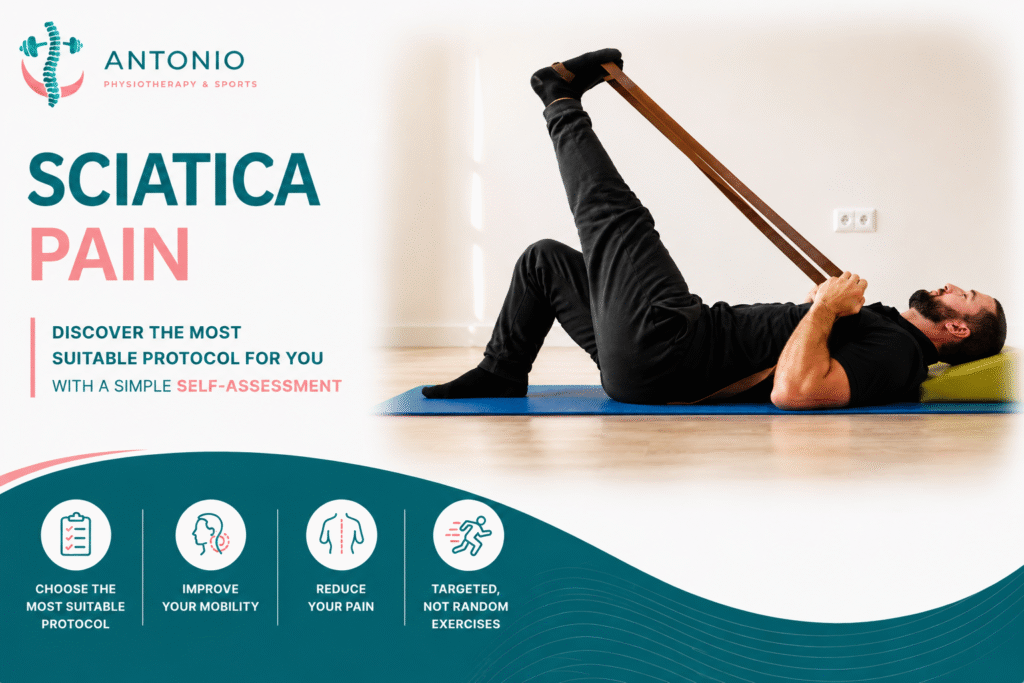
Sciatica is a term commonly used to describe pain, tingling, numbness, or discomfort that radiates from the lower back into the buttock, leg, or foot.
However, not all cases of sciatica are the same.
In some people, symptoms may be related to nerve compression or irritation. In others, symptoms may be associated with increased tension placed on the nerve during certain movements or positions. There are also situations where structures such as the piriformis muscle may contribute to symptoms that resemble sciatica.
For this reason, performing generic exercises found on the internet is not always the best approach.
In physiotherapy, understanding the characteristics of the problem first allows for a more appropriate selection of exercises and rehabilitation strategies.

ANTONIO
I am Antonio, a physiotherapist specialising in musculoskeletal conditions and the founder of PhysioCareHub.
Our philosophy is simple:
Understand the problem before trying to solve it.
For this reason, we have developed a Complete Sciatica Assessment designed to help you better identify the characteristics of your symptoms and guide you toward the most appropriate protocol.
Complete Sciatica Assessment
If you experience pain radiating into the leg, electric shock sensations, tingling, numbness, or symptoms commonly associated with the sciatic nerve, our assessment may help you better understand your condition.
Through guided questions, photographs, and simple self-tests, you will be able to identify whether your symptoms are more consistent with:
✔ Compressive components.
✔ Neural tension components.
✔ Possible involvement of the piriformis muscle.
✔ Other functional factors commonly associated with sciatic pain.
The goal is not simply to perform exercises, but to help you choose the most appropriate protocol based on the characteristics of your symptoms.
📖 Don’t worry if this PDF contains several pages
Everyone experiences pain differently, which is why this programme includes several rehabilitation protocols.
After completing the guided self-assessment, you’ll be able to identify the section that best matches your symptoms and go directly to the exercises and recommendations designed for your specific situation.
This way, you can focus only on the information that is most relevant to you, without having to read the entire document.
Why complete an assessment before starting?
Two people with similar symptoms may require completely different rehabilitation strategies.
For this reason, identifying the characteristics of the problem first can help you select more appropriate exercises and avoid following programs that may not fit your specific situation.
Our assessment was designed with exactly this goal in mind: helping you understand your symptoms before beginning an exercise program.
Support
If you have any questions, need additional information, or are simply unsure which option is best for you, we are here to help.
You can contact us at:
We will reply as soon as possible.
You are not alone in this process.
Antonio
PhysioCareHub